
I was thirteen years old the first time I got scammed.
A guy in Varrock told me he could trim my rune armour. All I had to do was hand it over and wait. I traded him everything I had. He logged out. And just like that, weeks of grinding were gone.
I didn’t know it at the time but that was my first lesson in financial literacy. Not from a textbook. Not from a classroom. From a medieval fantasy clicking game that accidentally taught an entire generation of players how money actually works.
I’ve been playing Old School RuneScape on and off for most of my life. I now work in compliance and administration at an accounting firm, where I spend my days navigating financial regulations and keeping complex systems from falling apart. And the longer I work in finance, the more I realise that almost everything I understand about how markets function, I learned first in a video game.
The Grand Exchange isn’t just an auction house. It’s a stock exchange. And nobody told the players.
Bid, ask, and the space between
For anyone unfamiliar with OSRS, the Grand Exchange is a centralised marketplace where players buy and sell items. You place an order for what you want to buy and the price you’re willing to pay. Sellers list items at the price they’re willing to accept. When a buyer’s price meets or exceeds a seller’s price, the transaction completes automatically.
There’s no buyout button. No “add to cart.” Just a bid price and an ask price, exactly like a limit order book on a real stock exchange.
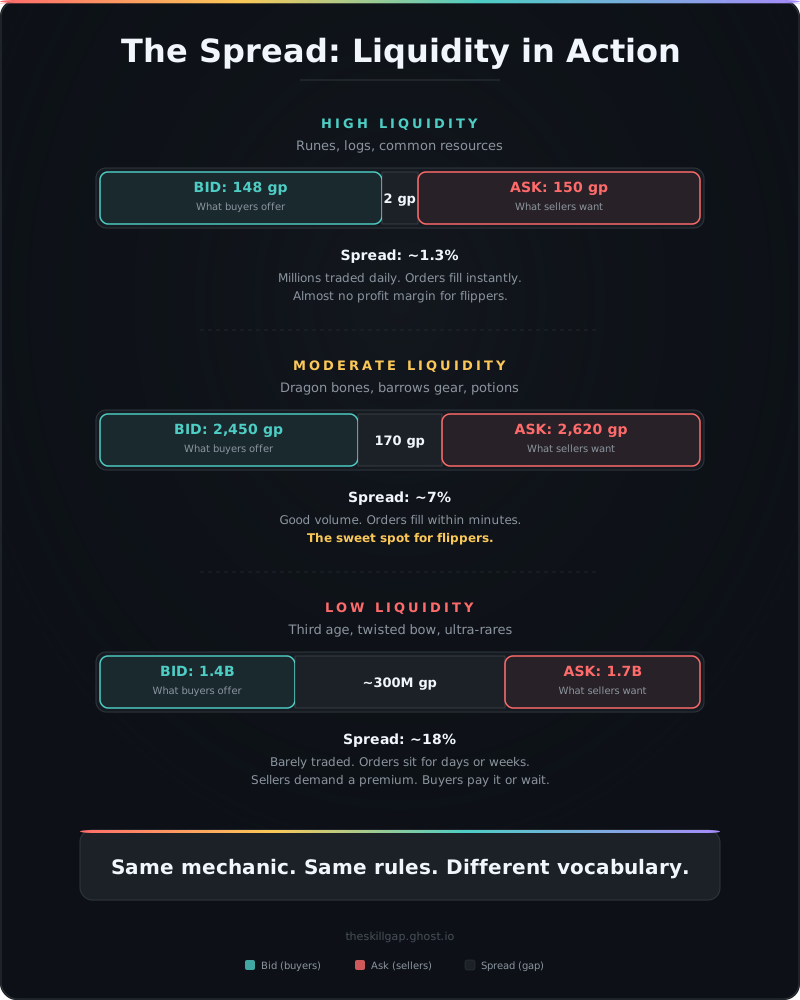
This creates something that most players learn intuitively without ever hearing the term. Spread. The gap between what buyers are offering and what sellers are demanding.
For high-volume items like runes or logs, things that are consumed by the millions every day, the spread is tiny. There are so many buyers and sellers that the price settles into a tight equilibrium. You can bid a gold piece or two below the going rate and your order fills almost instantly. That’s high liquidity. Lots of movement, lots of volume, minimal gap between bid and ask.
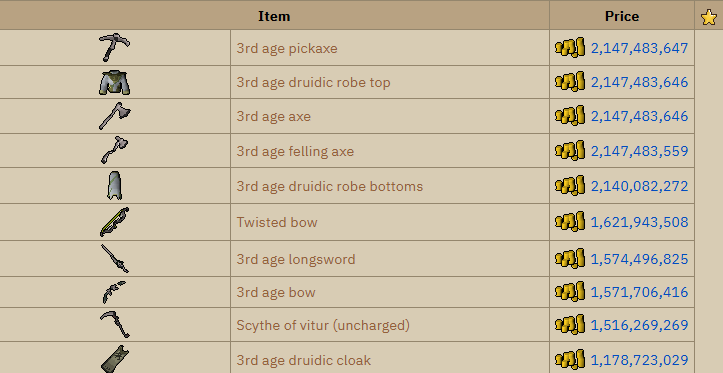
Then there are items like third age gear. For context, third age pieces are among the rarest items in the game. Some are worth over two billion gold. The supply is minuscule because they only enter the game through an extremely rare drop table. The demand exists but there are so few sellers that the spread is enormous. The “actual” price, the midpoint between average bid and ask, might say one thing. But if you want the item NOW, you’re paying a 10 to 20 percent premium above that number because the seller knows you have almost no alternatives.
That premium has a name in real finance. It’s called the illiquidity premium. Fund managers talk about it when pricing private equity investments or thinly traded securities. OSRS players figured it out at fourteen. They just didn’t have the vocabulary for it yet.
Flipping is market making
Once you understand spread, you understand flipping. Buy at the bid price. Sell at the ask price. Pocket the difference. Repeat.
Every OSRS player who has flipped items on the Grand Exchange has functioned as a market maker. That’s not an analogy. That’s literally the job description. Market makers on real exchanges like the NYSE or ASX exist to provide liquidity. They stand between buyers and sellers, they buy what people want to sell and sell what people want to buy, and they take the spread as compensation for that service.
The strategy is identical in both contexts. You don’t flip highly liquid items because the spread is too thin to be worth your time. You don’t flip extremely rare items because the volume is too low and you’ll sit on your inventory for days. You find the middle ground. Items with moderate demand and moderate supply where the spread is wide enough to profit from but the volume is high enough that your orders actually fill.
Any day trader reading this right now is nodding. Because this is asset selection. It’s the same decision-making framework whether you’re flipping dragon bones on the GE or trading mid-cap stocks on the ASX. What’s the spread? What’s the volume? How fast can I enter and exit the position? What’s my risk if the price moves against me while I’m holding?
A fourteen-year-old sitting in the Grand Exchange learning these principles by trial and error is developing financial intuition that most people don’t encounter until university. If they encounter it at all.
Investing on patch notes
Trading is one thing. Investing is another. And OSRS players do both.
When Jagex, the company behind RuneScape, announces a new piece of content, something changes in the economy before the content even goes live. Players who pay attention start buying.
A new end-game boss is coming out next month. That boss will require players to use specific consumables during the fight. Potions, food, ammunition, protective gear. The demand for these items is about to spike dramatically when thousands of players rush to attempt the new content on day one.
So what do you do? You buy those consumables NOW, while the price is stable, while most players haven’t thought that far ahead. You stockpile. And when the content drops and the demand explodes, the equilibrium price shifts upward. You sell into the surge and take the profit.
This is event-driven investing. Hedge funds do exactly this around earnings announcements, regulatory changes, product launches, and macroeconomic data releases. They analyse what’s coming, predict how the market will react, position themselves ahead of the move, and sell when the prediction plays out.
The information source is different. Patch notes instead of earnings reports. Developer livestreams instead of central bank press conferences. But the analytical framework is identical. Anticipate demand. Position early. Sell into the reaction.
And the best part? In OSRS, this information is public. Jagex announces their content roadmap openly. Everyone has access to the same patch notes. The edge doesn’t come from having secret information. It comes from being one of the few players who actually thinks about the economic implications of what they’re reading.
Which brings us to a much darker parallel.
The pump and the dump
Not everyone plays fair.
In OSRS, organised groups of players execute a scheme that would land them in prison if they did it with real securities. It’s called a pump and dump, and it works exactly the way it sounds.
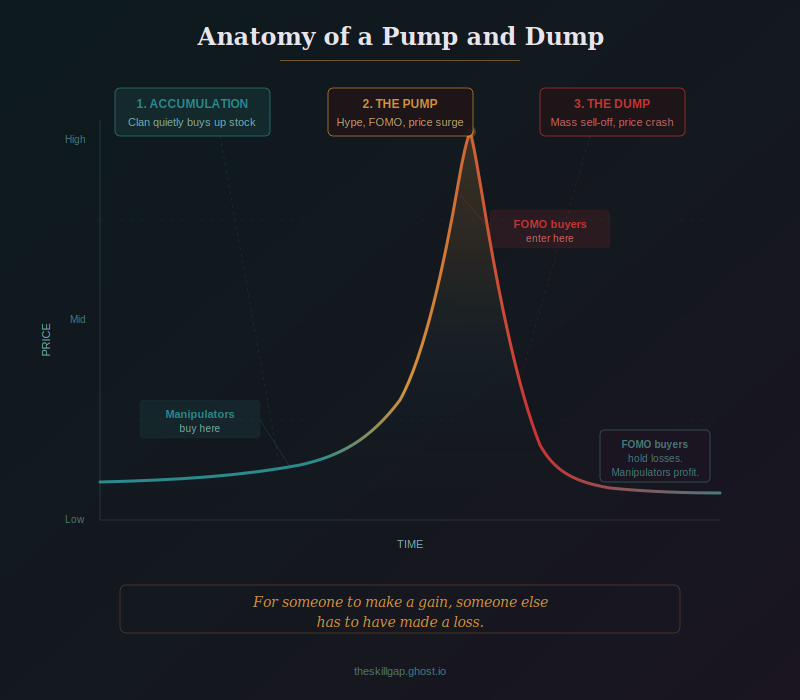
A clan coordinates to quietly buy up large quantities of a specific item over several days. Once they’ve built their position, they flood forums, Discord servers, and Reddit with posts claiming the item’s price is about to skyrocket. “Buy now before it’s too late.” Screenshots of the price chart going up. Urgent language. Manufactured hype.
Other players see the price rising and the posts everywhere and FOMO kicks in. Fear of missing out. They start buying, which drives the price up further, which creates more FOMO, which drives more buying. The cycle feeds itself.
Then the clan dumps. They sell their entire stockpile into the inflated market. The sudden oversupply crashes the price back to where it started, or lower. And every player who bought in during the frenzy is left holding items worth a fraction of what they paid.
For someone to make a gain, someone else has to have made a loss. Money doesn’t materialise from nothing. This is a fundamental rule of trading, in games and in life.
One of my favourite movies, The Big Short, has a scene that captures this perfectly. Brad Pitt plays Ben Rickert, a retired trader helping two young investors profit from the 2008 housing market collapse. When they start celebrating their gains, he stops them cold. Those gains came from people losing their jobs. Their homes. Sometimes their lives. The money didn’t appear from nowhere. It transferred from people who couldn’t afford to lose it.
Trading sits in a weird ethical space. You’re not providing a product or a service to the person on the other end of your transaction in any direct sense. They might be selling to cut their losses, and the best you’re offering them is the ability to exit. But your trading activity also creates the liquidity that allows markets to function at all. Without buyers, sellers can’t sell. Without sellers, buyers can’t buy. The market maker is simultaneously profiting from the spread and enabling the entire system to operate.
OSRS players navigate this tension intuitively. Most don’t articulate it. But they feel it. The first time you profit from someone else’s bad trade, you learn something about markets that no textbook teaches as effectively.
When a game studio becomes a central bank
Every economy needs to manage its money supply. Too much currency in circulation and prices inflate. Too little and the economy stagnates. Central banks use interest rates, bond purchases, and reserve requirements to control this balance. Jagex uses gold sinks.
In OSRS, new gold enters the game constantly. Monsters drop coins. Activities generate currency. The money supply grows every single day. Without intervention, this causes inflation. Items that once cost thousands of gold now cost millions. The max cash stack in OSRS is 2,147,483,647 gold, a number dictated by the way integers are stored in the game’s code. Once upon a time, that number seemed unreachable. Now there are individual items that sell for multiples of it, requiring workarounds just to complete the transaction.
That’s inflation. Not theoretical. Not hypothetical. Visible, measurable, experienced by every player who watches prices climb year over year.
Jagex combats this with gold sinks. Mechanics designed to remove currency from the economy permanently. Construction costs gold to level. Dying costs gold through item reclamation fees. Recharging degradable equipment costs gold. Each of these systems exists partly as a game mechanic and partly as fiscal policy. They pull currency out of circulation to slow inflation.
And then there’s the tax.
In 2022, Jagex introduced a 1 percent tax on all Grand Exchange transactions. Every trade now removes a small amount of gold from the game permanently. This is, in every functional sense, a financial transaction tax. Governments around the world debate these constantly. The Tobin tax. Securities transaction taxes. The arguments for and against are the same in OSRS as they are in real fiscal policy. Does it reduce harmful speculation? Does it hurt ordinary users more than it helps? Does it actually slow inflation or just redistribute the burden?
The community reaction mirrored real-world tax debates with eerie precision. Frequent traders complained about the cost burden. Casual players welcomed the deflationary effect. Some argued it didn’t go far enough. Others said it was government overreach, or in this case, developer overreach.
A game studio accidentally became a central bank. And its player base accidentally became an electorate with strong opinions about monetary policy.
The Varrock classroom
Before the Grand Exchange existed, trading in RuneScape happened face to face. Players stood in Varrock, the game’s main city, and typed out what they were buying or selling. You negotiated directly. You inspected the trade window. You hoped the other person was honest.
They often weren’t.
I learned about scams before I learned about supply and demand. Rock hammers swapped for granite mauls in the trade window at the last second. “Free armour trimming” that was just theft with extra steps. Wilderness lures where someone would convince you to follow them into a PvP zone and kill you for your gear. Lending items to friends who turned out not to be friends at all.
Every single one of those experiences was a lesson in fraud detection. In trust verification. In reading people and situations for red flags. And every kid who got burned in Varrock came out the other side with an instinct for spotting bad deals that would serve them for the rest of their lives.
But the education went far beyond avoiding scams.
When OSRS first launched, a friend and I noticed something. The cost of a gold bar plus an emerald was significantly less than the price of an emerald ring. And an emerald ring, once enchanted, became a ring of duelling, a teleportation item in high demand.
We set up an operation. He bought emeralds in bulk. I mined gold ore and smelted bars. We met at the end of each session, crafted rings, enchanted them, and sold the finished product on the market. Our profit was roughly 500 gold per ring on a base cost of 1500. That’s a 33 percent margin.
We turned 10,000 gold into 100,000. Then into millions. Eventually other players found the same gap, competition increased, and the margin disappeared. The arbitrage window closed as the market corrected itself.
Read that back in business terms. We identified an arbitrage opportunity between raw materials and finished goods. We established a supply chain with division of labour. We manufactured a product, added value through enchanting, and sold at a margin. When competitors entered the market, price equilibrium eroded our advantage.
That’s a complete business case study. Two teenagers executed it without a single business class between them.
The transcript nobody issued
Here’s what I keep coming back to.
Millions of people have played RuneScape. Millions of them have used the Grand Exchange. And through using it, they’ve developed intuitive understanding of bid-ask spreads, liquidity, market making, event-driven investing, inflation, fiscal policy, fraud detection, supply chain economics, and arbitrage.
Nobody gave them a certificate. Nobody listed it on a transcript. Nobody told them that what they learned flipping dragon bones was the same thing a trader learns in their first year on a desk. The knowledge is real but it’s invisible because the classroom was a game and society doesn’t take games seriously.
I work in compliance now. I navigate financial regulations for a living. And I can trace a direct line from the Grand Exchange to my understanding of how markets function. Not because the game taught me theory. Because it taught me instinct. The feel for when a price is wrong. The reflex to check the spread before placing an order. The awareness that someone is always on the other side of the trade.
The golden lie is that gaming is a waste of time. But the Grand Exchange is a functioning financial ecosystem that has been quietly educating its users in market mechanics for over twenty years.
The players just didn’t know they were in class.