
It was a Tuesday night and I was sitting in Discord staring at spreadsheets.
Not work spreadsheets. Raid spreadsheets. Forty names deep. Attendance percentages, gear wishlists, role assignments, a loot distribution system with a built-in decay formula that we’d argued about for two weeks before someone finally built it. If you’d walked past my desk you’d have assumed I was doing project management.
You wouldn’t have been wrong.
I’ve spent thousands of hours in MMOs, specifically World of Warcraft Classic, running 40-person raids with a guild full of people I’d never met in person. And I now work in compliance and administration at an accounting firm in New South Wales, where I spend my days navigating regulatory frameworks and keeping complex systems from falling apart.
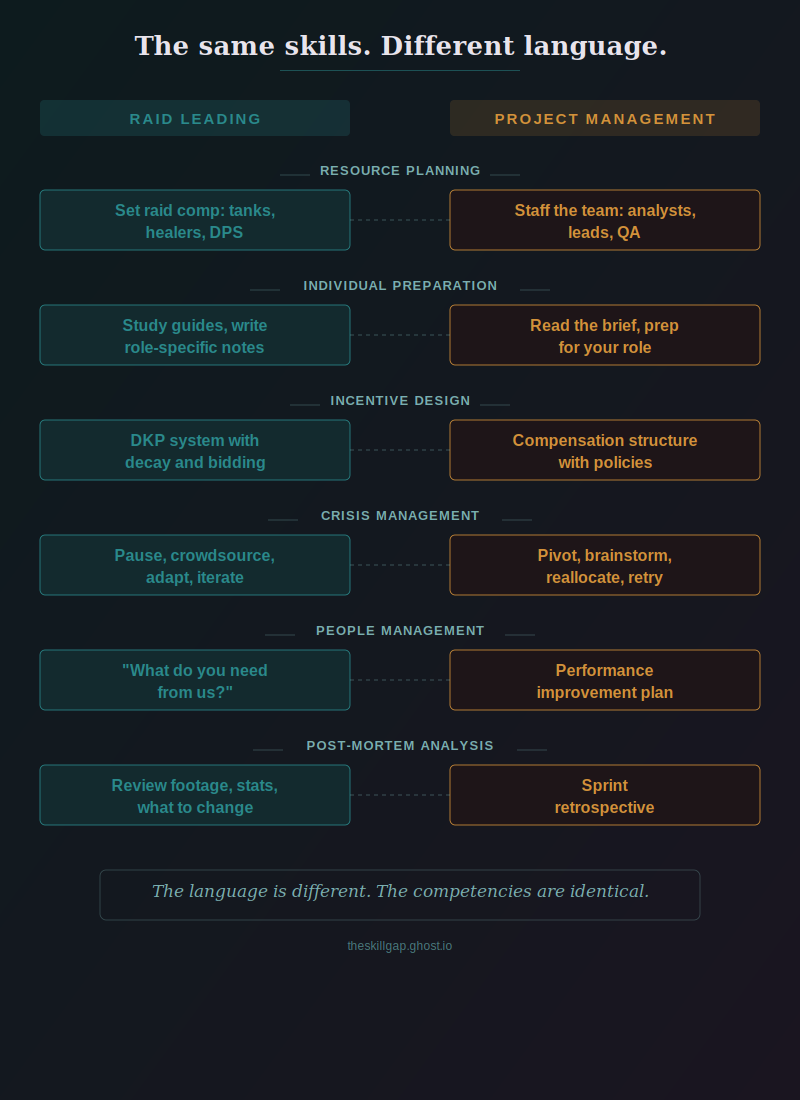
And somewhere between those two worlds I noticed something that nobody seems to talk about. The skills are the same. Not similar. Not “kind of like.” The same. The language is different but the thinking is identical.
Raid leading is one of the most complete project management training grounds I’ve ever seen. And I want to walk you through exactly why.
Nobody zones in raw
For anyone who hasn’t played WoW, a raid is basically this: forty players log on at the same time, enter a dungeon together, and fight a series of bosses. Each boss has unique mechanics. Specific things that will kill you if you don’t handle them correctly. Mess up and everyone dies. Start again. Burn through another round of consumables. Try not to yell at anyone.
Nobody sensible walks into that blind.
I played a healer. My entire job was keeping people alive. So before every raid night I’d sit down, watch video guides for each boss we were attempting, and write notes. Not general notes. MY notes. For MY role. What debuffs I needed to dispel. When the tanks were going to take sudden damage spikes. Which mechanics were specifically my responsibility to handle. I’d have a handwritten list next to my keyboard like a student cramming for an exam.
Every single member of the raid was expected to do the same thing for their own role. Damage dealers practised their attack rotations. That’s the specific sequence of abilities that maximises their output. Tanks mapped out where to stand and how to move the boss. Everyone studied the mechanics that applied to their class and assignment.
Here’s the thing. That’s project scoping. That’s understanding the deliverable before you start the work. A developer doesn’t start coding without reading the brief. A healer doesn’t zone into Blackwing Lair without knowing the dispel list. The instinct is exactly the same. Know what’s expected of you and do your homework so you’re not the reason forty people have a bad night.
Bringing the right tools
Before every raid the leader had to set the team composition. How many tanks. How many healers. How many damage dealers and which type. And it wasn’t just about filling spots with warm bodies. It was about filling them correctly.
Every decision came down to matching what the boss required against what each player could deliver. Some fights needed heavy healing output to survive sustained damage. Others needed raw damage to beat enrage timers, which is a hard time limit where the boss just kills everyone if you’re too slow. Some fights required very specific utility: players who could remove certain debuffs, control groups of enemies, or provide buffs that the rest of the team needed to survive.
So you’re sitting there going “right, we need enough damage to kill this thing before the timer, but we also need enough healing to keep everyone alive through the hard phases, AND we need three people who can dispel this specific poison or we wipe instantly.”
That’s workforce planning. That’s a project manager looking at a deliverable and going “I need two analysts, a designer, someone with attention to detail, and we need it done by Thursday.” If the project requires design work you bring someone with an eye for design. If the raid requires three priests who can dispel poison you bring three priests who can dispel poison.
The thinking is identical. The only thing that changes is the vocabulary.
The accidental compensation system
This is where it gets really interesting. And honestly? This is the part that made me realise the bridge between gaming and professional life isn’t just a cute analogy. It’s structural.
Our guild used a system called DKP — Dragon Kill Points. It was an internal currency that members earned by doing things that helped the guild. Attending raids. Running dungeons with other members. Farming materials for the group. Supporting newer players. Every contribution earned you points.
When a boss dropped a piece of gear, members would bid their DKP. Highest bid wins the item. Effort in, reward out. Simple.
Except we had a problem. The most active players were stockpiling enormous amounts of DKP and outbidding everyone else every single time. So we introduced a decay. Every fortnight, everyone’s balance dropped by ten percent. Hold your points too long and they lose value. This encouraged people to spend regularly instead of hoarding, and it kept access to rewards somewhat normalised across the group regardless of who could play sixteen hours a day versus who had a full-time job.
Worked well. Mostly.
But it also generated disputes that were fascinatingly similar to workplace arguments about pay.
Our most active raiders felt punished by the decay. They’d earned those points through months of consistent attendance and they watched ten percent evaporate every two weeks. That felt like a penalty for dedication. On the flip side, more casual members who’d spent all their points on an item nobody else wanted felt like they’d wasted their currency. Especially when something they actually needed dropped the following week and they had nothing left to bid.
Both sides had a point. Both felt the system was unfair. Just in opposite directions.
The resolution came through our admin council. A group of guild officers sat down with both perspectives, heard people out properly, weighed the impact on the guild’s long-term health, and made a decision for the collective good. The decay stayed, but we added transparency around drop rates and bid history so people could make better decisions about when to spend and when to hold.
Now. Read that back. An internal economy with earned currency. A decay mechanism to prevent hoarding. Disputes about fairness resolved through a governance council with due process.
That’s not a game mechanic. That’s compensation management. The decay mirrors use-it-or-lose-it annual leave policies. The disputes mirror workplace grievances about pay equity. And the resolution process? Hearing both sides, weighing impact, deciding for the group. That’s HR mediation. With arguably more due process than a lot of real companies manage.
When the plan falls apart
No plan survives first contact. That’s as true in Blackwing Lair as it is in any project.
There were nights we’d just hit a wall. Boss wasn’t dying. We’d burned through hours of consumables, adjusted positioning, swapped assignments, and people were still dying at the same point in the fight every single pull. That’s when the raid leader called everyone out of the boss room.
And what happened next was one of the most genuinely collaborative processes I’ve experienced in any setting, professional or otherwise.
Forty people in a voice channel. The leader opens the floor. “What are you seeing from your position? What’s killing you? Does anyone have an idea we haven’t tried?”
No idea was dismissed. And that mattered more than it might sound. In a group of forty there are always quieter members. People who know their class inside out but aren’t naturally inclined to speak up in a crowd. Making space for those voices was a deliberate choice. And more than once it was the quiet player who had the solution that nobody else had thought of.
We’d try the new approach. Sometimes it worked. Sometimes it didn’t and we’d go again. But sometimes the problem wasn’t the strategy. It was one person consistently making errors that cost the whole group.
That’s the hardest call in raid leading. And it maps directly to one of the hardest calls in management.
You can’t let thirty-nine people keep wiping, spending hours and resources and emotional energy, because one person can’t execute their role. But the way you handle it matters enormously.
In our guild the first step was never removal. It was a conversation. And that conversation didn’t start with “you need to do better.” It started with “what do you need from us?”
Maybe they were cracking under the pressure to perform and it was making them anxious. Maybe they couldn’t afford the consumables. Maybe they didn’t fully understand their class abilities and needed someone to walk them through it. Maybe they just needed to watch someone who was doing it well and learn from that.
The point was to find the root cause before jumping to consequences.
If the support didn’t help, if the player refused to engage or the behaviour continued, then yes, removal was the outcome. But it was never done publicly. Never called out in Discord for everyone to see. A small group of admins would take them aside, have the conversation privately, and give them the option to step back on their own terms.
And toxicity? Same principle. If someone was being aggressive or making other members uncomfortable, it was handled privately. A quiet conversation. “This is how your behaviour is affecting people. We’d like you to tone it back and apologise.” If they got explosive and refused? They were removed. We had a firm stance. If you can’t admit to your mistakes and humble yourself enough for a simple apology, you need to go.
Google’s Project Aristotle, their massive study into what makes teams actually work, found that psychological safety is the single most important factor in high-performing teams. Not talent. Not resources. The feeling that you can take risks and make mistakes without being humiliated for it.
A guild in Discord, run by volunteers with zero HR training, figured that out on their own. Not because they’d read the research. Because they understood instinctively that people perform better when they feel supported.
The debrief
After a hard raid, nobody wanted to analyse anything. Everyone was mentally cooked. So the debrief happened the next day.
The admin team would review footage and statistics: who died where, which healing assignments fell short, where the damage dropped off, what mechanics were getting missed. Then we’d ask the same three questions every single time.
What went well? What didn’t? What are we changing before next week?
The answers fed directly into planning for the next raid. Adjustments to team comp. Changes to role assignments. Updated strategy notes shared with the full group.
If this sounds familiar it’s because it’s a sprint retrospective. The same framework that software development teams, marketing teams, and project managers use worldwide. What worked, what didn’t, what do we commit to improving. The methodology is identical. One version happens in a boardroom with a whiteboard. The other happens in a Discord channel with a spreadsheet.
The bridge nobody’s building
I’ve been in both rooms now. I’ve coordinated forty people through a raid night and I’ve managed compliance deliverables at an accounting firm. And the overlap isn’t cute. It’s not a metaphor. It’s a structural reality.
Raid leaders scope projects. Staff teams. Design incentive systems. Manage crises in real time. Conduct difficult performance conversations with genuine empathy. Run retrospectives that feed into continuous improvement. They do all of this unpaid, under pressure, with a volunteer workforce that can quit at any time with zero notice.
If anything, the constraints are harder than most professional environments. You can’t threaten someone’s livelihood to keep them in line. You have to actually lead. Through trust. Through competence. Through giving a damn.
The next time someone tells you gaming is a waste of time, ask them this: have you ever managed forty people through a crisis, redesigned a compensation structure on the fly, and coached an underperformer back to confidence — all in one evening, all unpaid, all because you cared about the outcome?
That’s not gaming. That’s leadership.
And the only difference between the raid leader and the project manager is that one of them put it on a résumé.